
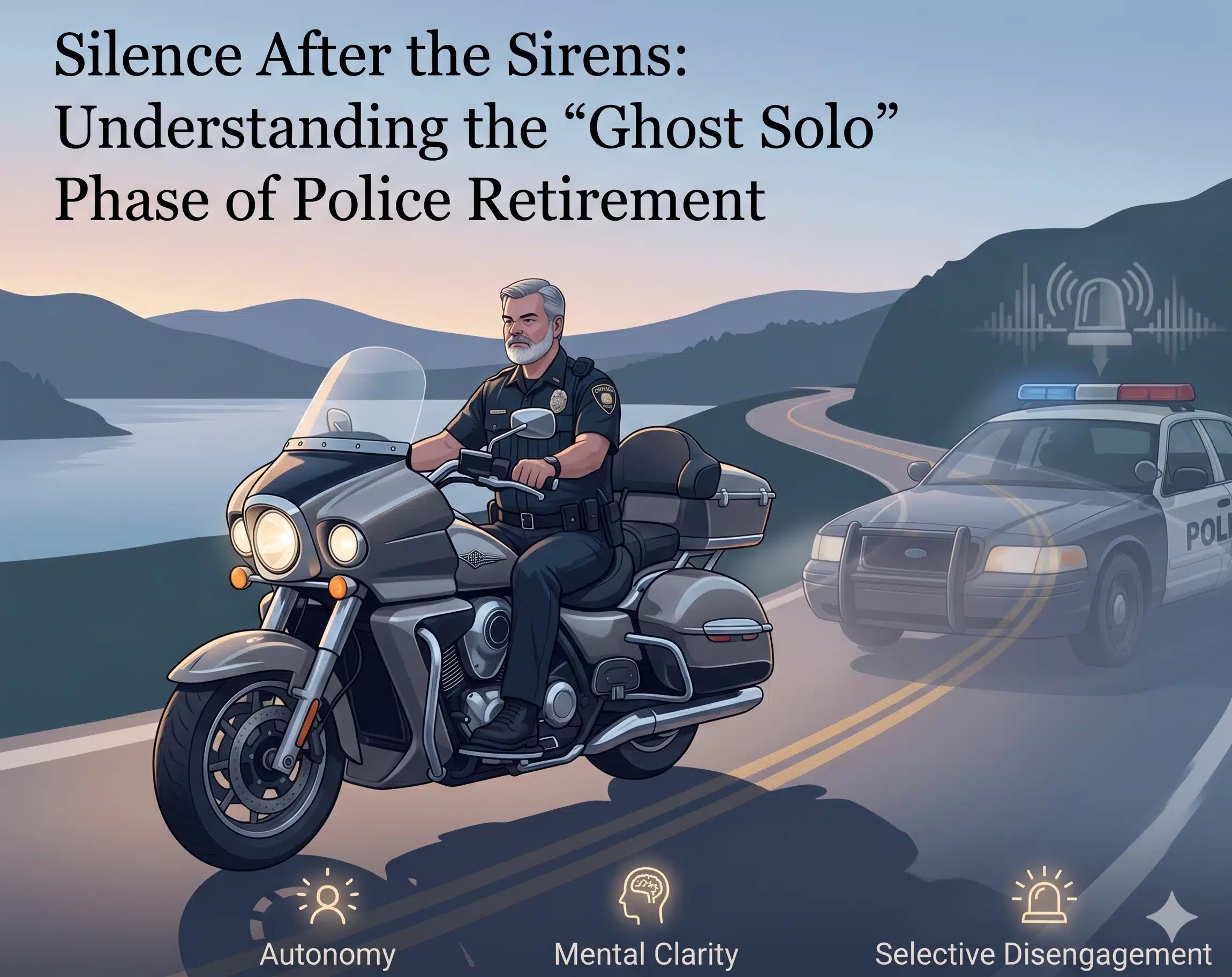
Retiring law enforcement officers often experience a difficult transition known as the ghost solo phase, characterized by social withdrawal and biological decompression. This isolation results from a sudden drop in hypervigilance and the loss of close professional networks, making public environments feel overwhelming and alienating for many former officers.
The stoic culture of policing frequently prevents retirees from seeking external support for trauma or identity loss. Instead, successful reinvention involves finding new, structured missions that offer purpose without the stress of public interaction. Transitioning into solitary, disciplined activities allows individuals to navigate post-career challenges and build resilient new identities.
The transition out of law enforcement is rarely as simple as turning in a badge and walking away. While well-meaning civilians often wish departing officers a “happy retirement,” the reality is that leaving the force represents a profound biological, psychological, and social disruption.
For many former officers, the immediate aftermath of a career in public safety isn’t characterized by relaxing on a beach, but rather by a deep, sudden need to disconnect completely from society. This deliberate withdrawal—often referred to by retirees as going “ghost solo”—is a widely misunderstood phase. To truly understand why retired officers isolate themselves from large crowds and the public scene, and why they prefer to solve their own issues rather than seeking outside help, we have to look at the unique psychological and physiological toll of the badge.

Table of Contents
Why Retired Officers Avoid the Public Scene
The Drop Off the “Hypervigilance Cliff”
During an active career, the constant threat of unpredictable violence forces an officer’s brain and autonomic nervous system into a chronic state of hypervigilance. Their bodies become accustomed to sustained adrenaline and cortisol spikes to maintain a constant state of operational readiness.
When an officer retires, they abruptly fall off the “hypervigilance cliff”. Stripped of the daily high-stakes stimuli that once fueled them, their nervous systems experience a massive biological crash, leading to profound fatigue and emotional numbness. Avoiding large crowds and public interactions is often a neurobiological necessity—the body’s way of seeking a low-stimulus environment to safely decompress and recover from decades of chronic stress hormones.
Loss of the “Protective Membrane”
The isolation is also deeply social. Because of the adversarial nature of policing, officers routinely avoid making non-police friendships during their careers to protect themselves from civilian misunderstanding. They rely on a tight-knit, closed support network of fellow officers that acts as a “protective membrane”.
When retirement hits, that membrane evaporates. Without the daily camaraderie of their squad, retirees frequently feel like they are “out of sight, out of mind,” making large public scenes feel incredibly alienating and uncomfortable.
The Culture of Silence: Solving Their Own Issues
Emotional Toughness and the Stigma of Help
When faced with the anxiety, identity loss, and untreated trauma that often surface during retirement, why are officers so hesitant to seek outside professional help?
The answer lies in the deeply ingrained police subculture. Policing historically values emotional toughness, suppression, and absolute control. During active duty, officers are conditioned to use “emotional distancing” to survive the daily misery and chaos of the job. Over time, this stoic culture reinforces the idea that showing vulnerability or talking to outsiders is a sign of weakness. As a result, many retirees suffer in silence, preferring to handle their struggles internally rather than risking judgment from civilians who simply “don’t get it.”
The Danger of Maladaptive Coping
Because retired officers are prone to tackling their transition alone, they are at a high risk of falling into maladaptive coping mechanisms. Left unchecked, the combination of identity loss and untreated trauma can trigger the “lethal triad” of isolation, anger, and the projection of blame. Some may resort to destructive behaviors like substance misuse or complete emotional withdrawal.
However, isolation does not always mean maladaptive coping. Deliberate decompression can be incredibly healthy when channeled properly.
Finding a New Mission Outside the Public Eye
Redefining Purpose on Your Own Terms
Overcoming the void of retirement doesn’t mean forcing yourself back into public-facing roles or starting a retail business. As retirement experts note, successful reinvention is about finding a new way to maintain a mission without the bureaucratic stress.
For some, “going ghost solo” looks like learning the complex, analytical mechanics of trading options and futures—a solitary, structured challenge that replaces the split-second decision-making of the streets. For others, it means protecting their peace by participating in Patriot Guard or Tour of Honor motorcycle rides, choosing to honor fallen heroes in a tightly-knit, purposeful community rather than dealing with the general public.
Conclusion
The silence after the sirens can be deafening, but the instinct to step back and disconnect is a normal, biological response to an abnormal career. By replacing the adversarial stress of the public eye with disciplined, self-directed missions, retired officers can successfully navigate the hypervigilance cliff and build a resilient post-policing identity on their own terms.